Forget Chatbots: 5 AI Use Cases That Drive Immediate ROI for Fashion Brands (AI Starting Kit Included)
 Kasia Ryniak
Night Mode

AI isn’t new to fashion. But for years, it was mostly skin-deep: chatbots, digital stylists, and headline-friendly experiments that rarely stuck. Meanwhile, behind the scenes, a quieter revolution is underway.
From LVMH’s internal AI platform (MaIA), which handles over 2 million monthly queries across brands like Dior, Tiffany, and Celine, to fast fashion giants like Zara and H&M, the industry is shifting focus. Instead of flashy, consumer-facing experiments, leading fashion brands are now investing in embedded AI agents that automate operations, improve margins, and unlock internal knowledge.

This is not a runway moment that captured attention, but a quiet operational revolution.
This article distills our experience with 5 use cases that fashion CTOs should care about now. They are real, already deployed across the industry, and ready to be customized to your stack, especially if you're open to open-source frameworks like Enthusiast and LangChain.
1. Conversational Product Discovery
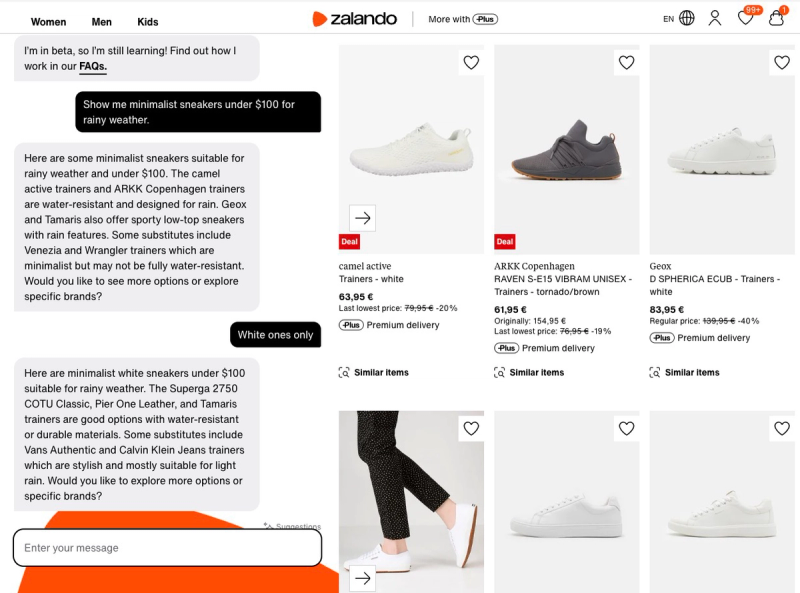
Filters are being replaced by natural-language interfaces. See the below picture as an example for searching for a pair of minimalist sneakers under $100 for rainy weather.
Why this matters:
- Before: Shoppers abandoned after too many filter clicks or incomplete search results.
- After: AI translates natural queries into catalog-specific filters, returning precise results.
- ROI: Higher conversion, reduced bounce rate, and improved customer experience.
Who's doing it: Zalando uses semantic search to power conversational discovery. LVMH is integrating similar interfaces across brand sites.
2. AI-Driven Product Tagging and Catalog Management
Transform raw product data into structured, multi-attribute metadata automatically. This is one of the most requested use cases by our clients.
Why this matters:
- Before: Merchandisers spent hours manually tagging SKUs.
- After: Automated product tagging, categorizing SKUs with brand-consistent and industry-specific vocabulary, speeding up catalog management and improving searchability.
- ROI: Faster time-to-publish, stronger SEO, cleaner navigation filters.
Who's doing it: Adore Me, mid-sized DTC brands using open-source pipelines.
3. Smarter Demand Forecasting
Analyzing historical sales, seasonal trends, and even external variables like weather or regional events, AI models can predict future demand with greater precision.
- Before: Inventory planners relied on spreadsheets and post-hoc analysis.
- After: AI models forecast style-level demand, feeding recommendations to merchandisers in real time.
- ROI: Less overstock, better margin, fewer markdowns.
Who's doing it: Amarra, a global dress distributor, was able to use AI cutting overstocking by 40%. This is also widely adopted by fast fashion companies like H&M, Shein.
4. AI-Enhanced Design Workflow
Embed AI directly into the product creation pipeline. From generative sketches to material suggestions, the design phase is becoming faster, more informed, and more collaborative.
- Before: Designers worked off mood boards and instinct, disconnected from merchandising, market data, or past collection performance.
- After: AI analyzes bestseller data, seasonal patterns, and external signals (like TikTok trends) to generate design briefs, suggest colorways, and even co-create sketches or 3D mockups.
- ROI: Reduced sampling rounds, faster concept-to-launch cycles, and tighter alignment between design and sell-through performance.
Who's doing it: Tommy Hilfiger partnered with IBM and created an AI-powered design lab.
5. Internal Knowledge AI Agents
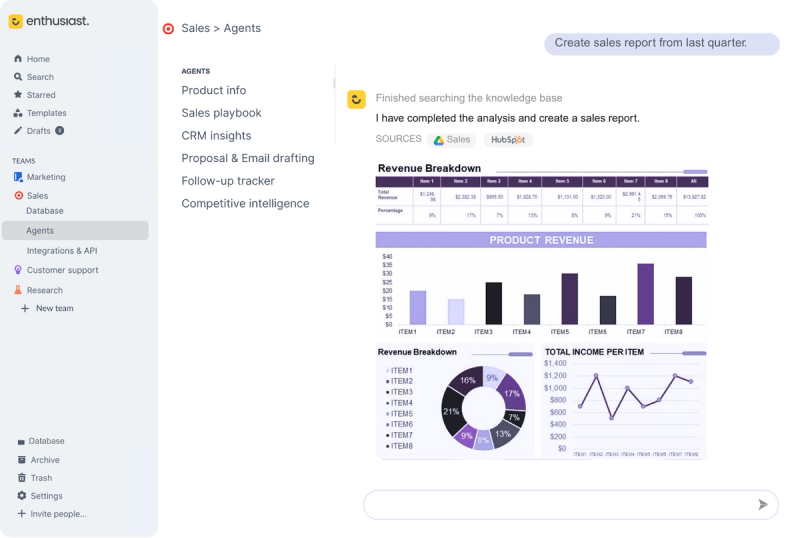
AI-powered internal knowledge management base that scales knowledge across departments, which allows building agents at scale.
- Before: Teams manually pulled reports, searched Google Sheets, or asked around for insights.
- After: Role-specific agents that answer questions, draft reports, surface insights, and more. Each agent draws from the same knowledge base but is tuned for different workflows, greatly reducing response time and improving accuracy.
- ROI: Smarter, faster decisions.
Who's doing it: LVMH through MaIA to handle its 75 maisons.
Through using open source platforms like Enthusiast or LangChain, companies not only can fast prototype their AI based knowledge base, but also build agents for different use cases at scale.
How to start? Good news. You Don’t Need a Massive AI Team!
The best part? You don’t need perfect data, a full MLOps pipeline, or a seven-figure budget to get started. Many brands begin with lightweight pilots that prove ROI quickly, often within weeks.
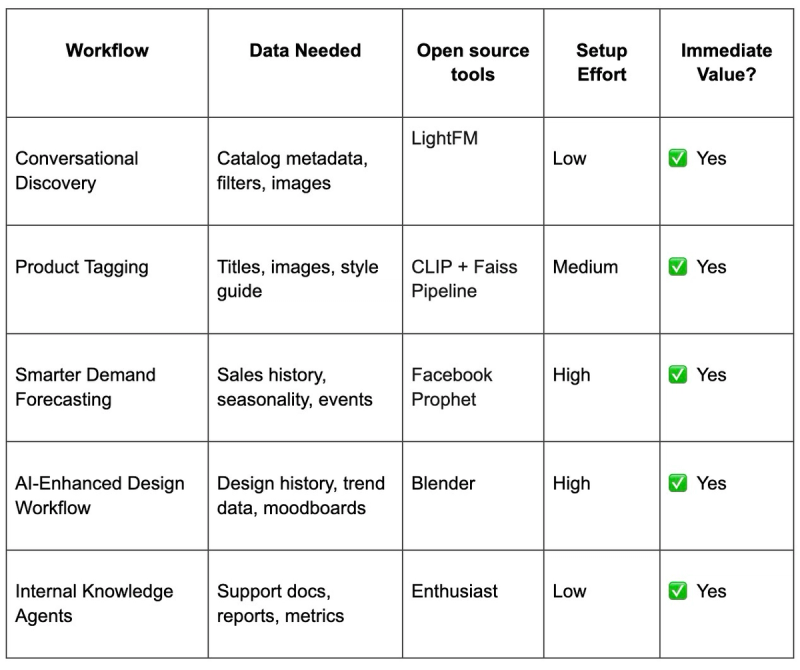
Below is a quick-start matrix designed for fashion teams. It highlights what each use case needs, what tools can accelerate experimentation, and whether it’s worth testing immediately.
Need an easy entry to get started?
Join our upcoming live workshop to learn how to build your own AI-powered knowledge assistants using Enthusiast, our open-source framework for agentic AI workflow automation. Whether you want to unify product data, generate insights, or deploy conversational agents across departments—this session will show you how to start. 🔗 [Reserve your spot here]
Explore More Blog Posts

The AI Design Gap: Moving Beyond One-Way Generation
There are plenty of tools capable of generating code from designs or directly from prompts. In theory, this looks like a dream scenario. It drastically shortens the journey from design to frontend development. The handoff is quicker, the design is easier to implement, and everyone involved is happier. Right?
 Karol Podżerek
Migrating an ERP-Driven Storefront to Solidus Using a Message-Broker Architecture
Modern e-commerce platforms increasingly rely on modular, API-driven components. ERPs… do not. They are deterministic, slow-moving systems built around the idea that consistency matters more than speed.
 Mateusz Porębski
Automating Purchase Orders in E-Commerce: How Agentic AI Handles Unstructured Input
In an era of connected e-commerce, it’s easy to assume that every order flows cleanly through APIs or online checkouts. The reality, however, may be very different, especially in industries where B2B and wholesale operations still rely on unstructured, offline, or legacy input formats.
Kasia Ryniak